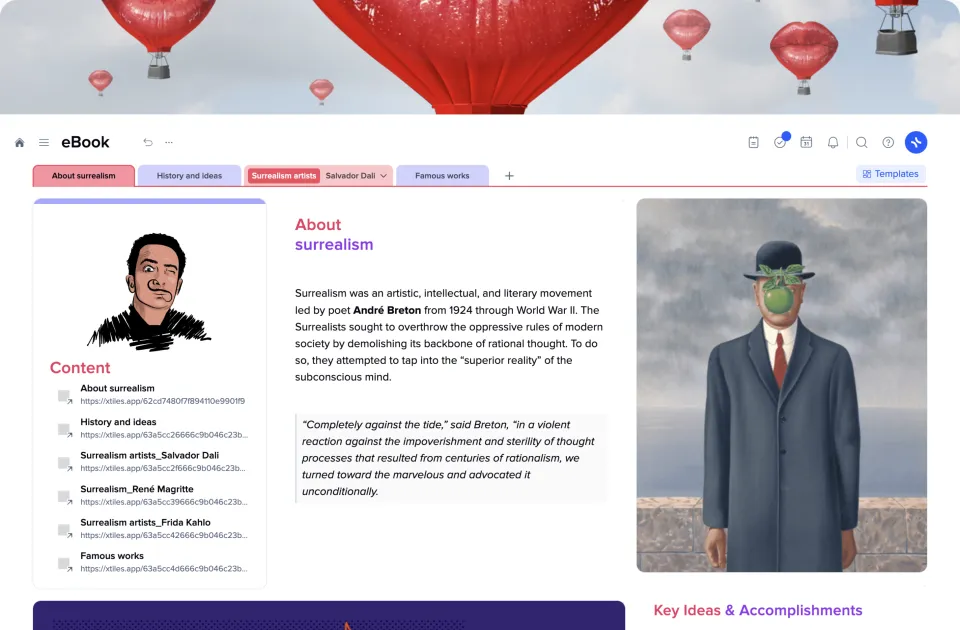
Why release an eBook?
eBooks have become increasingly popular in recent years due to their convenience and the fact that you can release a book without printing houses and agencies.
Annually more than 190 million eBooks are sold in the USA, and the number is growing faster than the number of printed book sales (while print book sales increased only 13%, eBook sales grew by 22% in 2021).
eBook templates empower you to bring any book you imagine to life, no matter your writing, designing, and publishing skill level. It can also greatly assist marketers in constructing a well-rounded content marketing strategy.
We live in a crazy yet beautiful world full of possibilities where a free eBook template may help you create a book that changes your and your readers’ lives.
The xTiles eBook template offers a simple yet sophisticated pre-designed structure for organizing your future eBook. We also provide an example of an eBook to help you grasp the concept and a detailed guide on writing your own.
Publishing an eBook has numerous advantages in comparison to traditional printing books. While the world of printed literature stays almost closed to non-literature people, without mentioning a couple of loopholes, eBooks open a wide range of opportunities.
Tirelessly pestering for years and waiting for a publisher is a part of the biography of many famous authors. If only they knew that the path a book has to overcome from a manuscript to a reader is much shorter today.
Here are some of the significant benefits associated with eBook publication:
- Cost-effective publishing
Creating an eBook typically involves lower costs compared to print publishing. No printing house will delay copies of the book. There will be no problem with storage or physical distribution. Additionally, if you’re acknowledged with designing and promotion, you can release your book on your own.
- It’s easier to reach a global audience with eBooks
While a physical book has overcome a long path to land in other countries, an eBook needs less than e second to be downloaded somewhere in the other hemisphere. Digital platforms and online marketplaces allow authors to reach a global audience without limitations of physical distribution.
- It’s an accessible way to share your unique insights and perspectives
An eBook allows you to share your knowledge, skills, thoughts, ideas, and expertise on a specific subject with a wide audience.
- An eBook helps to establish authority and credibility
Releasing an eBook can help you establish yourself as an authority in your field. It positions you as an expert and enhances your credibility among readers, potential clients, or industry peers.
- You can generate income with eBooks
eBooks can serve as a potential source of income when sharing your knowledge, skills, thoughts, ideas, etc. You can sell your eBook directly to readers or distribute it through various platforms, earning royalties from each sale.
- eBooks provide flexible publishing options
Self-publishing guarantees great control over the process. You set your timeline, choose designs, set pricing, etc. An author gets the freedom to experiment at each stage of the publishing process with different ideas and concepts.
- You don’t have to be a writer to release your eBook
eBooks may become a part of your content marketing strategy, education course, manuals for students, etc. Getting in touch with a publishing house may be too much for a one-time action. That’s why a self-publishing eBook is a solution to many issues, especially when it comes to filling gaps in your field of expertise.
- eBooks help save the planet and environment
And last but not least, eBooks significantly reduce deforestation. Additionally, since they don’t need physical transportation, they also reduce carbon footprint and pollution.
Being an accessible way to publish content, eBooks may bring significant income to their authors. Everything will depend on your field of expertise, the topic, your target audience, and the current demand for the information you provide.
Also, your country of residence and its eBook market condition will have an impact on how much you can earn from your books. For example, the eBook industry in the United States alone generated $1.1 billion in revenue in 2020.
However, some countries have weak or no regulations for torrenting copywriter materials. So, if you live in one like that and publish content in your native language (so foreigners can have no advantage of it), your potential earnings from writing an eBook are, unfortunately, lower.
Here are some ways in which you can make money from writing eBooks:
- Direct sales
You can sell your eBooks directly to readers through various platforms or your own website. An effective marketing strategy and well-balanced price can generate revenue from each sale.
What is an eBook template?
An eBook template is a pre-designed framework or layout that helps to create an eBook with less effort and in a shorter time. Many authors use it as a starting point for designing and formatting their books.
Normally, except for a predefined structure, a template offers a range of customization options, such as styles, page layouts, typography choices, and others, to fit the specific content of the book or author’s intent.
eBook templates help to ensure the consistency of all elements throughout the book, making it visually appealing and professional, which shows the author’s credibility and proves that someone spent much of their time to provide readers with something special.
Additionally, taking care of formatting, layout, and design, an eBook template helps authors focus on content creation rather than spending excessive time on formatting and design aspects.
Ready-to-use templates also help to make book covers to give people something to judge the book on. An eBook cover template helps avoid involving a professional designer in creating your book cover with minimum effort and minimum knowledge about design and polygraphy.
There are many options to choose from when deciding on a template for your future book. For example, Microsoft Word offers various pre-designed templates specifically for creating eBooks.
These eBook Word templates often include different layout options, font styles, and chapter headings that you can customize according to your content. Yet they often lack flexibility, and if you plan on adding some illustrations to your book, it may become even harder to structure pages in a visually appealing way. eBook templates for PowerPoint have the same disadvantages.
Another popular option is an eBook template for Google Docs. However, since the tool duplicates only a part of Office Word functionality, you will face even more inconveniences when structuring your book and aligning text.
eBook InDesign templates offer many well-designed page layouts, typography styles, and other design elements, yet the software requires some onboarding since it was created for professional use.
Also, you can find eBook templates designed for your specific book intent. For example, a recipe eBook template to share your best dishes with the world or a fitness eBook template to share your fitness journey to motivate others is pretty popular.
How to write an eBook using the xTiles eBook Template?
Suppose you want to share your knowledge with the world or anyone ready to read creating an eBook. What’s next? You have the template that will serve you faithfully during your path, yet there are some aspects to remember before you start, while you are working on, and once the book is finished.
Let’s delve deeper into the magnificence of eBook creation.
Who is the target audience of your eBook?
Think about the people you’re writing your eBook for. How old are they? What is their gender? What do they do for a living? What hobbies do they have? What do they dream about? Imagine someone who combines all the needed characteristics to like your book.
Knowing your target audience is also helpful for defining what platforms or methods you will use for marketing and distributing your book.
If you struggle to imagine your perfect reader, try to answer the following questions:
- What problems do I try to address in my book?
- For whom my book may be helpful?
- What methods do I intend (or can) use to promote my book?
- What about my book will be of interest to my potential readers?
It’s advisable to decide for whom you will be writing your book. Otherwise, you might get overwhelmed with uncertainty and ambiguity during the writing process, or your book might contain everything at once, so no particular group of readers will find it interesting or worthy.
Select a topic for your eBook
It will be hard to start without a clear topic for your future book. It establishes the whole writing process. However, choosing one might be hard because it means that other topics you consider interesting or important stay uncovered, at least so far.
Here are some criteria to pay attention to when selecting a topic for your book:
- Significance and relevance
Consider the significance of the topic in relation to the goal you want to reach by releasing the book and to the target audience. How do they align? Remember that the topic should be relevant and valuable to your audience, helping them address challenges or achieve their goals.
- Uniqueness and fresh perspective
Will your book bring a fresh and unique perspective to the subject matter? Start with researching whether the topic has been extensively covered in existing resources.
In case you googled, and there are dozens of books on a similar topic, don’t get upset. It may be helpful to explore your topic from different angles and perspectives or specific niche areas within the broader topic to offer a distinctive take that sets your eBook apart from others.
Sometimes, by going deeper and offering a more narrow topic, you satisfy someone’s very particular needs that weren’t satisfied by all these books available.
- Potential readers benefit
Will your book provide valuable insights, practical tips, expert guidance, or actionable strategies to your target audience?
Understanding the specific needs and interests of your audience is key to a successful book. When it genuinely resonates with your readers, it becomes a valuable resource people want to share, discuss, and compare with their own experience.
- Market demand
Even though art is behind commerce, you can’t create a valuable book that resonates with readers without taking into account what they want.
If you want to make money with your eBook, you may go even deeper and apply methods SEO specialists use to create websites ranking high in search results.
Research keywords, search trends, and popular discussions to gauge the interest and engagement surrounding the subject. Identifying a topic with high demand and limited competition can increase the likelihood of your eBook gaining traction and attracting a larger audience.
Select a title for your eBook
The name of your eBook plays a crucial role in capturing the attention of your target audience. When choosing/creating the title, you need to ensure its relevance, uniqueness, and potential to resonate with your audience.
If you’ve decided on an eBook instead of publishing it, then you’re pretty much alone in this. There will be no witty and skilled editor who knows readers’ expectations to help you. However, there’s no need to despair. There are still plenty of options on how to come up with an eloquent name for your book.
You may learn from other authors’ experiences. For example, the famous “To Kill a Mockingbird” was initially titled “Atticus.” However, Lee Harper’s editor suggested the new title, which was taken from a passage in the book, and it became the enduring name of the novel. When your book is done, you may check whether there’s no great passage to use as the name that will create some kind of a circle within the book, matching the name and the text.
If you have a community of followers, you may ask their opinion. You may create a poll providing them with the annotation of the book, so they can choose what is the best.
Research
Benefits of Upgrading your xTiles Plan
- Access to advanced templates that make your planning, managing, tracking, and collecting a stunning visual experience.
- Unlimited personal spaces and pages to create and execute all of your projects, even the bravest ones.
- Unlimited spaces to share to work on group projects or manage teams.
- Recurring tasks to automate the planning process.
- Unlimited storage to save all of your information in one place.
- Google Calendar integration to manage your schedule from one place.
- Advanced color customization to enhance organization through custom palettes—because the visual aspect matters.
- A timeline view to visualize your projects and their approximate duration.
- Forms to gather data from anyone and save it to your collections.
- Linked pages to synchronize the information across multiple projects in real time.
- Priority support to get your answers anytime you need.